
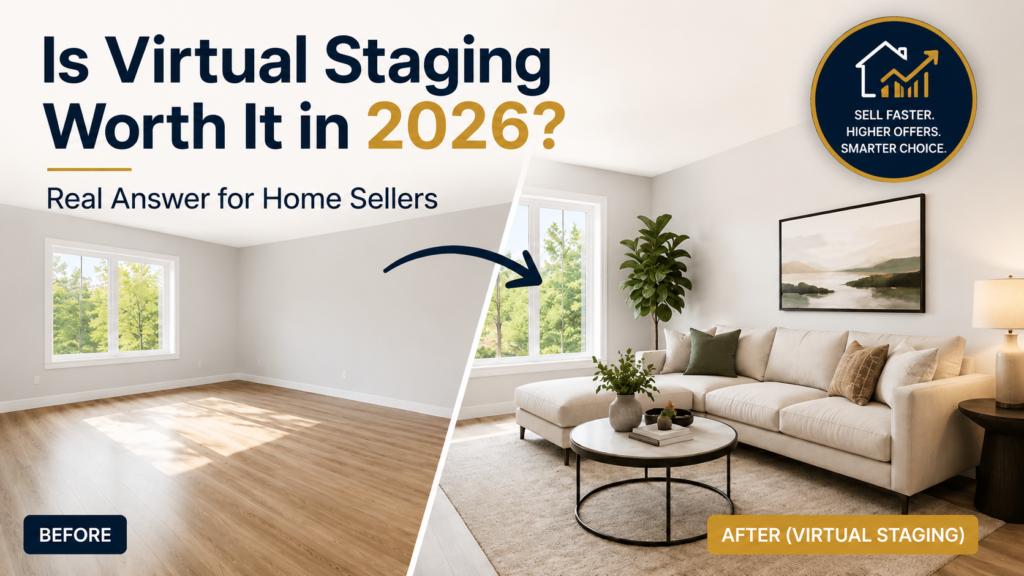
In 2026, selling a home is no longer just about location or price. It’s about how your property performs online. Buyers can view dozens of listings within seconds, and most decisions regarding the desirability of seeing a home are made before buyers ever walk through the door. This is where virtual staging makes all the difference in modern real estate marketing. But the real question sellers ask is: Is virtual staging worth it in 2026?
It’s important to understand what it actually does and when it works before you invest in it. In this guide, we break down everything that helps you to know how virtual staging is worth and whether it can truly help you sell faster.
Why Buyers Decide Before They Visit a Property
Most buyers never experience a home first; they experience it through photos. Those images act as the first showing, and they decide within seconds whether a listing is worth exploring.
At this stage, buyers are thinking:
- Does this space feel open and practical?
- Is it bright, modern, and comfortable?
- Can I imagine living here every day?
This is where online home buying behavior and the psychology of home buyers play a major role. Buyers are not just evaluating rooms while they are visualizing a lifestyle.
If that mental picture doesn’t form quickly, the listing loses attention, clicks, and inquiries. That’s why strong visuals directly impact property listing engagement and overall interest.
What Virtual Staging Actually Does
Virtual home staging is the process of digitally furnishing empty or outdated rooms using software or AI tools. It turns blank spaces into styled interiors that help buyers understand how a home could look when lived in.
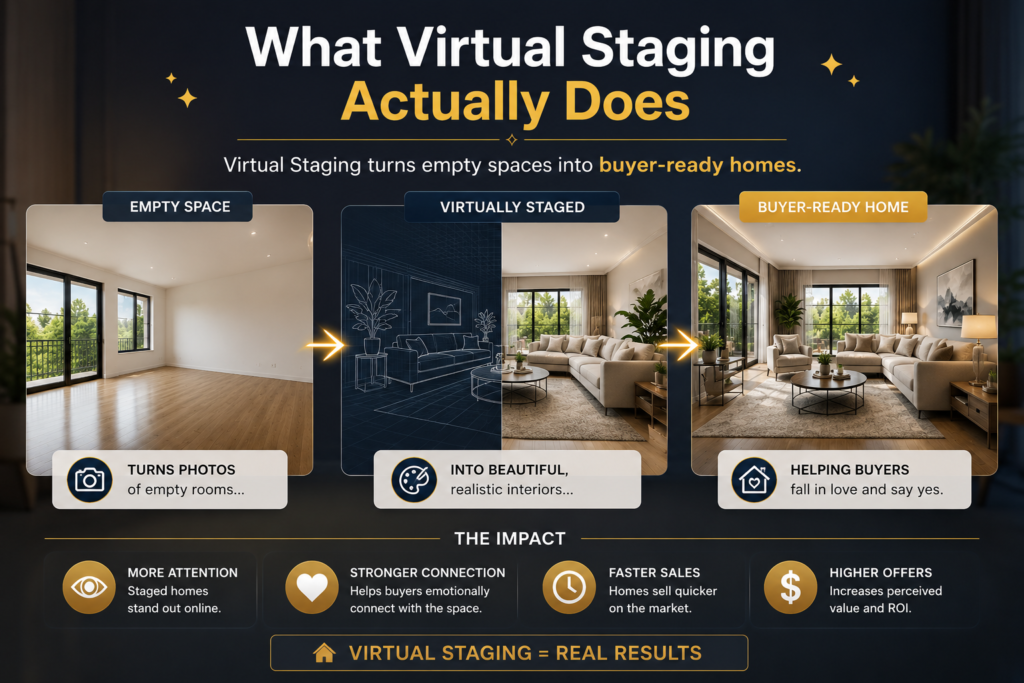
In 2026, Virtual Staging Services typically include:
- AI-generated furniture placement
- Realistic lighting and shadows
- Interior styles tailored to buyer profiles
- Fast delivery for online listings
It is widely used as part of real estate photo enhancement strategies to improve listing presentation.
However, it’s important to be clear about what it is not:
- It is not renovation
- It is not physical furniture staging
- It does not fix structural or lighting issues
It only improves how the home is visually presented online.
So, Is Virtual Staging Worth It?
The answer depends entirely on the situation.
It is worth it when:
- The property is empty or unfurnished
- Rooms feel unclear or uninviting in photos
- The listing is competing in a crowded market
- The goal is to improve clicks and sell the house faster online
It is not worth it when:
- The home is already well-furnished and visually strong
- Photos suffer from poor lighting or quality issues
- The property has visible structural problems
Virtual staging is not a universal solution; it is a presentation strategy.
What Virtual Staging Actually Improves
When used correctly, virtual staging for real estate improves how buyers interpret a property.
It helps:
- Make the room purpose the room’santly clear
- Turn empty spaces into livable environments
- Improve visibility in listing search results
- Strengthen emotional connection with the home
This emotional clarity matters because it reduces hesitation. Buyers don’t waste time figuring out the space; they immediately understand it.
Virtual staging before and after comparisons can also help boost click-through rates in many instances, as the transformation is a powerful visual.
Does Virtual Staging Help Sell a House?
It can, but indirectly.
Does virtual staging help sell a house?
Yes, but not by changing the property itself. It improves attention and interest.
It can lead to:
- More clicks on property listings
- Higher inquiry volume
- Better understanding of layout
- Increased time spent viewing listings
However, it does not fix pricing, location, or property condition. It simply improves how the property is perceived online.
The Trade-Offs Most Sellers Ignore
While virtual staging benefits are strong, there are real trade-offs:
- Buyers may feel misled if expectations aren’t managed properly
- Over-styled interiors can feel unrealistic
- Some buyers prefer raw, unstaged images for trust
- Disclosure rules may apply depending on the listing platforms
Important point: virtual staging supports marketing; it does not change reality.
That’s why virtual ng increase offers are never guaranteed. It improves interest quality, not final pricing.
Virtual Staging vs Traditional Staging
Both approaches play different roles in home staging the impact on sales.
Physical staging
- Real furniture in real space
- Strong emotional impact during in-person visits
- Higher cost and logistical effort
Virtual staging
- Digital enhancement of listing photos
- Strong performance in online marketing
- Fast and cost-effective
In many cases, sellers combine both:
- Virtual staging for online listings
- Physical staging for premium showings
This is common in virtual staging for real estate agents workflows.
Virtual Staging Has the Biggest Impact
Virtual staging for vacant homes is especially powerful in:
- Empty homes with no visual reference
- New builds without furniture
- Rental or investment properties
- Budget listings competing online
In these situations, it improves vacant home marketing strategy and helps listings stand out quickly.
Where Virtual Staging Falls Short
Despite its strengths, virtual staging has limits:
- Poor-quality photos reduce effectiveness
- Structural issues remain visible
- Unrealistic designs can reduce trust
- Buyer expectations must be carefully managed
This is why success depends on execution quality and context, not just the tool itself.
The Real ROI for Sellers
Instead of overpromising, here is the real outcome:
- Higher listing engagement
- More clicks and inquiries
- Faster understanding of space
- Stronger first impressions online
It improves real estate listing competitiveness, not property value itself.
Important truth: it doesn’t guarantee higher offers, but it increases the chances of attracting serious buyers faster.
What Has Changed in Virtual Staging in 2026
The industry has evolved significantly:
- AI-generated interiors look highly realistic
- Turnaround time is often just hours
- Buyer-targeted styling is widely used
- Integration with listing platforms is seamless
Because of this, virtual staging services such as virtual staging homes or virtual staging offices are now a standard part of modern real estate visual marketing strategy.
How to Decide If You Should Use It
Ask yourself:
- Is my property empty or visually weak?
- Does it stand out in listing photos?
- Am I competing in a saturated market?
- Do I need faster online attention?
If mostly yes, then virtual staging is recommended. In case not, it may not be necessary.
Common Misunderstandings About Virtual Staging
Virtual staging is often misunderstood:
- It doesn’t increase property value: it improves perception
- It doesn’t replace photography: it enhances it
- Not all buyers prefer it: some prefer real photos
- It doesn’t work in every situation: it depends on context
Conclusion
In 2026, virtual staging is an effective asset to employ when enhancing the appearance of a property online and engaging with prospective buyers.
Ideal for empty properties, active markets, and properties that require enhanced visuals to be compelling.
It should not, however, be a substitute for proper photography, accurate pricing, or a property condition.
Virtual staging is not about selling the home; it’s about creating an exact representation of how people feel when living in the home. In 2026, it’s more often imagination that determines whether they click, enquire, or move on.
If you are looking for ways to make your listing presentation better, explore the Virtual Staging Studio and see how it can take your property marketing to the next level.
Ready to Transform Your Property Photos?
Get professional virtual staging that makes your property photos more attractive to potential buyers.